




Crafting a Strategic Approach to C-Suite Recruitment
Hiring a C-suite executive can be either a positive or challenging experience for your company. The stakes of executive recruitment are high, and traditional recruitment can prove to be risky and expensive.
Executive search strategies must follow a strategic approach rather than simply filling a role. This guide outlines the advantages of a strategic and data-driven approach to C-suite recruitment to benefit your company’s future.
The Hidden Costs of Poor C-Suite Hires
The consequences of an unsuitable C-suite hire extend far beyond direct costs, such as base salary and executive search fees. Hidden financial and cultural costs can affect your company in the long term, leading to lost revenue and reduced productivity.
Financial Implications
Financial implications can stem from an executive’s decision-making. For example, the executive may follow a specific method that misses a prime opportunity to generate revenue. There can also be cultural implications. Inadequate leadership can cause employees to leave your company, leading to recruitment expenses and executive search fees. The cost of replacing an employee is typically between 50% and 200% of their annual salary.
Low Trust and Cultural Disruption
It is challenging to assign figures to soft costs. However, a C-suite hire that disrupts the company culture and erodes employee trust is a significant problem. A leader’s actions and proposals to change how your company operates can increase employee turnover, leading to low performance and an unproductive work environment. Incompetent leaders may decide to focus on less pressing areas of the company, ignoring growth opportunities.
Why Traditional Recruitment Fails at the C-Suite Level
Senior leadership recruitment requires an in-depth style with a purposeful strategy to attract the right candidates. Here is why traditional sourcing fails in C-suite hiring:
- Generic job descriptions: You will find that a majority of job descriptions focus on a candidate’s experience and qualifications, with only certain information about the company. C-suite candidate job descriptions should include details about the company’s vision and goals, such as promoting digital services or identifying innovative ways to drive growth. Posting a job without these details risks attracting candidates who don’t align with your company’s outlook.
- Focusing on urgency: A typical job description emphasises the need to fill the role within a short time frame. This strategy works well if your company needs to move quickly. However, attracting C-suite candidates requires thorough planning, which takes time.
- Prioritising technical experience: Technical experience is fundamental to recruitment and a deciding factor in advancing candidates to the next stages. Hiring for a C-suite-level role involves going beyond this experience. Screening should cover an individual’s leadership experience and strategy implementation qualifications. Factoring in these skills alongside technical expertise offers deeper insight.
- Neglecting soft skills: Some recruitment processes overlook the soft skills that are fundamental to C-suite hires. Soft skills can include an individual’s decision-making skills under pressure and their adaptability in new environments. Today, leadership should comprise individuals with experience managing diverse workforces and the ability to respond to changing markets proactively.
Your 4-Step Strategic Talent Recruitment Framework
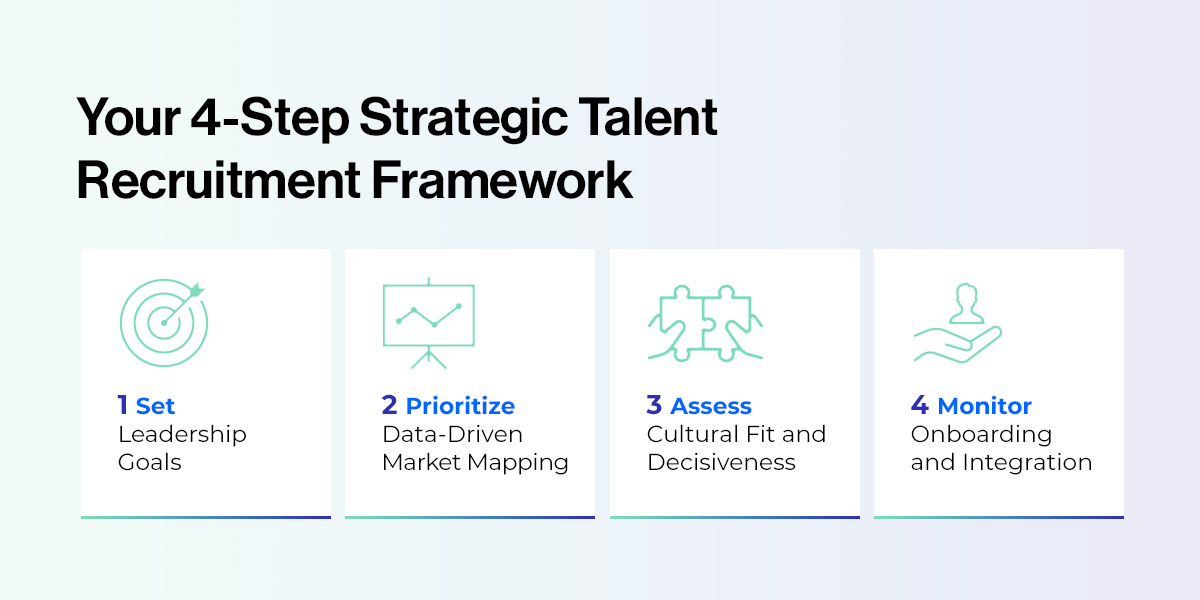
Finding the best C-suite talent requires a thorough, structured approach. Although traditional recruitment methods have their place, strategic executive hiring ensures candidates align with your long-term goals. Below are four steps for building a strategic acquisition framework:
Step 1: Set the Leadership Goals
Spend time defining your company’s version of success and what you’ll want the new executive to accomplish before drafting a job description. For example, think about whether your new leader should focus on improving efficiency or entering new markets. Consider time frames for these goals to provide candidates with a clearer picture. This information will help pair you with potential leaders who are a match for your company on more than just a skill level.
Step 2: Prioritise Data-Driven Market Mapping
Often, the most suitable candidates are already working in adjacent roles. These individuals may be working for companies with similar goals and plans to what you’re forecasting.
To approach these candidates, your strategy must include competitor and market analysis. Using data analysis helps you identify active and passive candidates. Additionally, incorporating data allows you to make hiring decisions without relying on convenience.
Step 3: Assess Cultural Fit and Decisiveness
Skills and experience can move candidates far along in the recruitment process. However, assessing behaviours and attitudes toward specific situations helps to pinpoint the strongest candidates. Consider introducing behavioural tests and assessments to analyse candidates’ responses and how they might impact your company. Evaluating decisiveness and cultural fit helps ensure you’re making the right hiring choices.
Step 4: Monitor Onboarding and Integration
Successful talent acquisition involves an informative onboarding experience. Without a clear structure, leaders can feel unclear about what they should achieve during their first few months in your company. A plan of action outlining performance metrics and how they contribute to company success keeps leaders focused on making an impact.
Industry Considerations for C-Level Executive Search
Executive job search strategies require an approach tailored to your industry. Certain personal attributes and skill sets are more critical to one sector than another. Consider a few examples for maximising C-suite talent recruitment in financial services and insurance and asset management:
Financial Services and Wealth Management
Leaders in financial services are responsible for promoting digital innovation and maintaining regulatory compliance. The financial services industry is subject to intricate regulations, with significant consequences for noncompliance.
Despite potential compliance challenges, creating financial digital services may require leaders with technical expertise to manage the operational changes. Wealth management leadership places particular emphasis on building industry relationships. Leaders must demonstrate their ability to sustain professional connections and build trust.
Insurance and Asset Management
Insurance and asset management leaders are adaptable to fast turnarounds. Emerging markets, such as insurtech, are changing traditional methods of working, including distribution and underwriting. Experienced leaders possess the knowledge of tried and tested methods and remain flexible in digital transformations.
The Advantages of Executive Search Solutions
C-suite hiring is more complex than traditional recruitment. The talent pool tightens as requirements become more specific, and hiring an incompatible candidate happens more often than not. This process also has more risks — the wrong candidate can have numerous impacts on your organisation.
Using C-suite executive search best practices and professional solutions is beneficial for any business.
- Access to larger talent pools: Working with a connected and experienced talent recruitment firm allows you to access a broader network of candidates. Executive search firms’ strategy is to continuously build relationships with leaders to identify the most suitable talent.
- Data-backed decision-making: Executive search consultants conduct data analysis that internal recruitment teams often cannot due to time and resource constraints. You can use data like competitor evaluations and research on leadership trends to guide your hiring choices.
- In-depth candidate assessments: C-suite hiring should involve more than just matching skills and experience. Executive search solutions use psychometric tools and behavioural assessments to limit bias and determine whether a candidate is a cultural fit.
- Consultative approach: Find an executive search firm that provides a consultative approach to your executive recruitment strategy. This approach can help you find a candidate who fits your requirements and supports your company’s growth goals.
Start Your C-Suite Leadership Talent Recruitment With Hanover
Our team of executive search strategy consultants began in a small London basement office and has grown into a global presence built to help you find the best C-suite professionals. With decades of industry experience, our team is passionate about making a difference with a trusted, innovative, collaborative and agile approach.
Our industry expertise spans the financial services sector, including investment management, operations, and technology. Contact the team today to begin your company’s growth journey with the right talent.


Related Posts